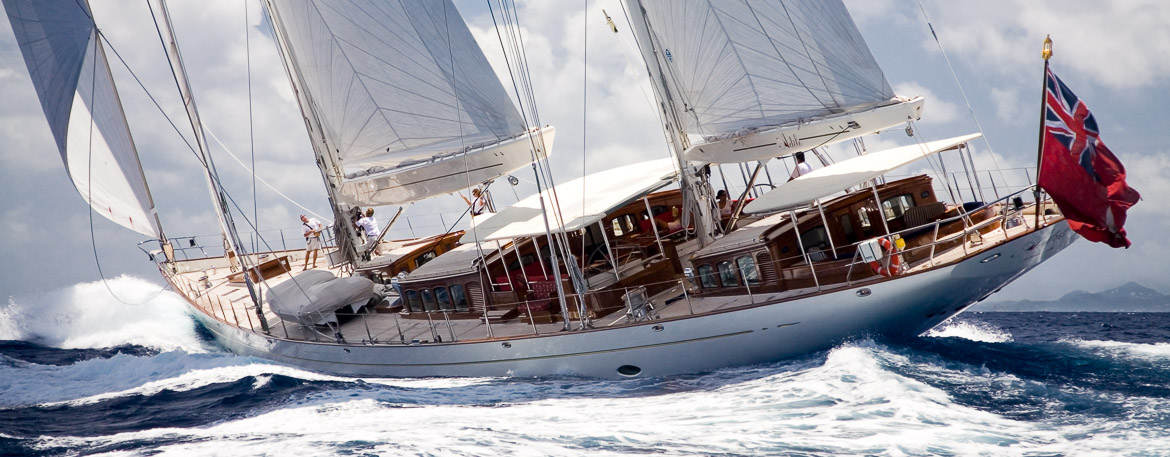
<< Vision of Adele
Sailing Adèle

Adèle is a powerful yacht and carries a large sail area both upwind and downwind, which together with her narrow hull will give her a lot of speed also in light weather.

She is a ketch and is therefore also more versatile, when reducing sail in hard weather, and in light winds it is easy to set a mizzen staysail, when reaching or running. The mizzen staysail substantially increases the sail area, but is still easy to set and handle.

 Adèle’s mainmast is as tall as possible to allow passage underneath the Bridge of the Americas (the Panama Canal Bridge). Including antennas, she reaches 63.6 m above the waterline.

Sails

Upwind, we are normally sailing Adèle with genoa and staysail, main and mizzen all set (close-hauled the staysail doesn’t contribute much). The total upwind sail area is 1,554 m2. All the upwind sails are made of Spectra with carbon reinforcements.

When the wind increases we must reduce the sail area. Upwind, we will first take away the mizzen and the staysail in around 14 knots of true wind (down to 1137 m2) (fig a) and then via several steps come to the position shown in fig b with one reef in the main and two in the genoa (773 m2) at around 26-30 knots of wind. Finally we would normally carry her stormsails (257 m2), one reef in the mizzen and one reef in the forestaysail, from around 45-50 knots of true wind depending on the wind angle.

Reaching, Adèle can also carry a mizzen staysail of 500 m2. This is a very useful sail and is easy to set and furl. It substantially improves performance in light wind and we expect to carry it quite often. It can be worn in anything from 70 degrees apparent in up to 20 knots on a beam reach and downwind in up to 28 knots of true wind speed.

The mizzen staysail is designed as a reaching sail and relatively flat. The clew is fastened to a small hydraulic furling unit built into the deck just aft of the forward deckhouse. We hoist the sail in a furled position (like a long sausage) and then unfurl it. The sail can be left in furled position but hoisted for easy redeployment, assuming Adèle doesn’t tack or gybe. It is stowed away in a special locker on deck.

Downwind, Adèle can set an asymmetric spinnaker (without a pole) of 1,500 m2. It is probably the largest spinnaker ever made (certainly the largest made by North Sails, which is the largest sail maker in the world). It is a full cut sail designed to be stable downwind, but not so easy (and not so important) to carry on a beam reach. Above all it gives a boost in light winds, but is a handful to hoist, sheet and to douse. To set the spinnaker we need the full complement of experienced sailors on deck.

We can carry the spinnaker in combination with the mizzen staysail or we can carry either alone. We wouldn’t normally keep the spinnaker flying in anything more than 25 knots of true wind.

We furl the spinnaker with a sock and then lower it through a special hatch in the forepeak. The sail is stored in a bag, which fills up most of the forepeak.

Reefing

The main and mizzen are furled via traditional slab reefing systems with “Park Avenue” booms, lazy jacks from boom to mast and full length battens in both sails. The main boom is 18m long and 1.35m wide.

The first design was based on in-boom furling for the main and mizzen, but the decision was taken that as Adele would be sailing in remote areas, a reefing system that would require the minimum amount of maintenance on the sails would be desired.

The lazy jacks and full-length battens give a much better control of the sail and of course the mainsail has a better profile giving higher upwind speed. To simplify reefing we have instead developed a reefing system, where the first reef is taken in on a captive winch working synchronized with the (also captive) halyard winch. Although it works like a push-button automated reefing system, nothing replaces the vigilance of the crew.

Both the main and mizzen are stowed on the booms by a car system, where every second car goes to port and every second to starboard helping the process of folding the sails and reducing the stacks of the cars (which is of considerable height anyway).

After the main or mizzen is hoisted, the top of the sails are locked in position by special locks on the masts that take all the tension. The halyard winch can then be released and the pressure on the mast is reduced. Cunningham and outhaul like the boomvang are adjusted hydraulically to assure optimal shape of the sail in all conditions.

The genoa and forestaysail are both carried on Rondal hydraulic furlers, and the sails are strengthened at the natural reefing points (see table). In heavy weather the sails are reduced in several steps depending upon the weather conditions, the sea and the wind angle.

The staysail and genoa are hoisted with the halyards taken to any of the mainmast winches. The halyards can then be tensioned by a hydraulic ram for each sail placed at the mast.

Rig and winches

The masts and booms are made of carbon fibre. All standing rigging is rod. A pole of carbon fibre is carried at the forward end of the main mast for hoisting and lowering the large tender.

We have a crow’s nest with seating for two persons on the main mast, which can be hoisted and lowered via a hydraulic captive winch controlled from deck or from the crow’s nest itself. It goes to a maximum height a little bit below the inner forestay (~40 m above waterline).

The spreaders are angled backwards (16? for mizzen and 20? for main). That means that in normal conditions we don’t have to set the running backstays, but we always set them on ocean crossings, in rough conditions or when motoring.

All upwind sails are sheeted through captive winches (Rondal). The mizzen staysail is sheeted through the mizzen boom and back to a winch at the mizzen mast. The spinnaker is sheeted to the big primary winches (Lewmar 150) placed either side of the mizzen mast.

We have 12 hydraulic captive Rondal winches (where the line automatically is rolled up on the winch drum) and 10 hydraulic Lewmar normal winches plus a couple of snub winches. Adèle also has two anchor winches forward and one for the stern anchor aft.

At the main mast there are two hydraulically operated Lewmar 111 winches and two manual 111 (to work as snubbing winches). At the mizzen mast there are two hydraulic Lewmar 111 winches. Those winches are there to

      • Hoist the yankee and staysail (main mast)
      • Hoist the MPS and mizzen staysail
      • Take in the second reef (main) or the reef (mizzen)
      • Sheet the mizzen staysail (mizzen)
      • Adjust the preventer lines
      • Hoist a person in the mast
      • Hoist the tenders and adjust the tender pole (main mast)

There are two primaries (Lewmar 150 SSHST) for sheeting the MPS and setting the runners. They can of course also be used for mooring lines. They are back winding for paying out the sheet (or running backstay) safely and can also be used as back up winches for the yankee, if the captive winches should fail.

There are two hydraulic winches behind the aft cockpit for mooring lines and running backstays for the mizzen mast (when set).

There are two hydraulic winches forward for mooring lines, for the downhaul line for the MPS and for control of the tender pole.

Sail Control

The sails (except spinnaker and mizzen staysail; see above) are sheeted to captive winches controlled at a central panel between the two steering wheels. The sails can also be controlled from portable controls that a crewman can carry, which means that he can be standing on the windward side with a full view of the shape of the sails, when he is sheeting or tacking.

There is also a position just aft of the forward deckhouse from which the sails can be controlled.

<< Vision of Adele
© 2005 All rights reserved.                 home   |  voyages  |  specifications  |  media   |  the book  |  contact